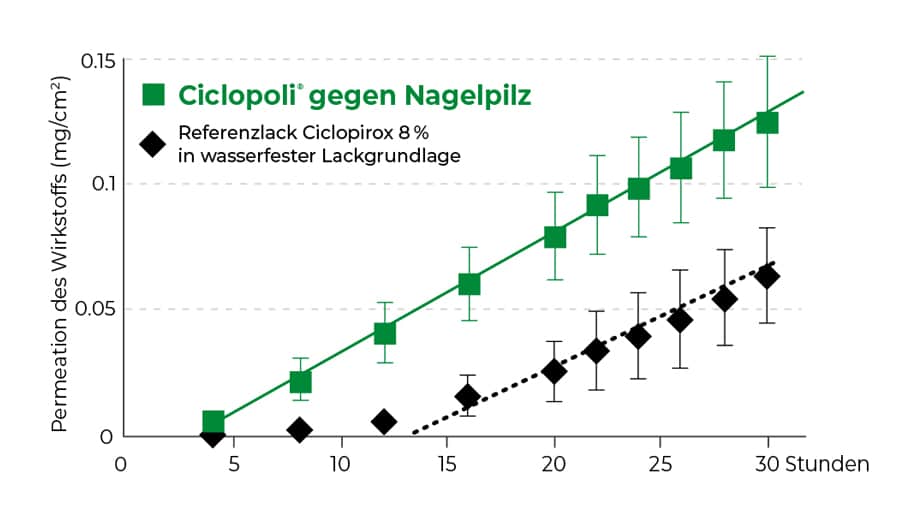
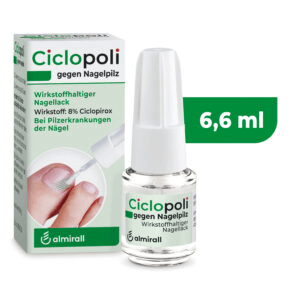
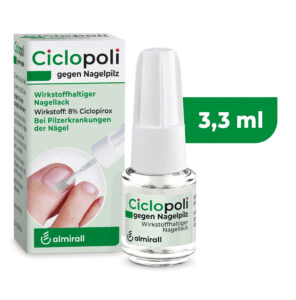
* Reichweite bei der täglichen Behandlung von drei Zehennägeln, darunter ein Großzehnagel.
** Komplett-Heilung = negative KOH-Mikroskopie und negative Pilzkultur und 100% gesundes Nagelwachstum in Woche 48, bestätigt in Woche 52 und Woche 60.
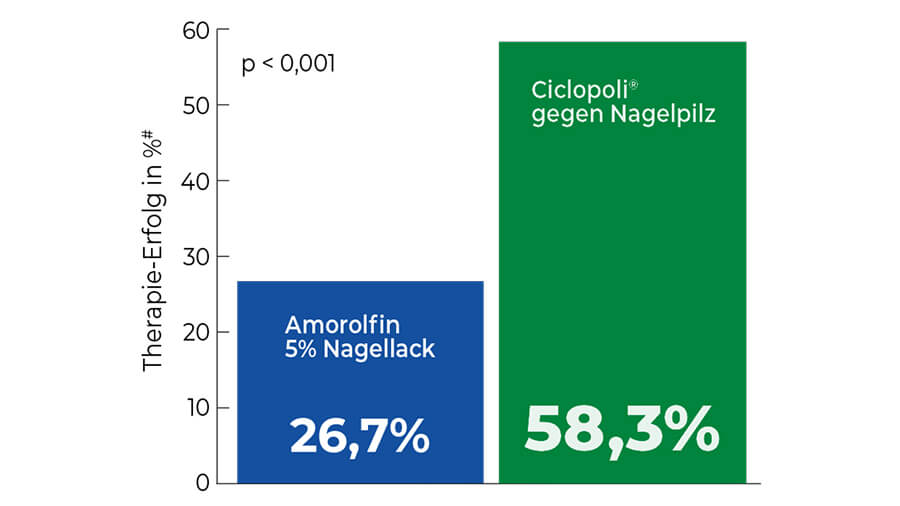
*** Komplett-Heilung (Complete cure rate, primärer Endpunkt) um 119% höher nach Woche 60.
- Wiedergabe der Ergebnisse aus Jorizzo M, et al. Skin Appendage Disord. 2015;1(3):134–40 [in der Fachinformation zu CICLOPOLI® gegen Nagelpilz (Stand: 11/2022)]. Therapie-Erfolg = Konversion zu negativer KOH-Mikroskopie und negativer Pilzkultur und ≤10% Restbefall des Nagels (verblindeter Gutachter).
- Baran R, et al. J Eur Acad Dermatol Venereol. 2008;22(7):773–81.
- Baran R, Tosti A, Hartmane I, et al. An innovative water-soluble biopolymer improves efficacy of ciclopirox nail lacquer in the management of onychomycosis. J Eur Acad Dermatol Venereol 2009; 23(7):773–781.
- Monti D, Saccomani L, Chetoni P, et al. Br J Dermatol. 2010;162:311–317.
- Monti D, Saccomani L, Chetoni P, et al. Drug Dev Ind Pharm. 2005;31(1):11–7.
- Nenoff P et al. S1-Leitlinie Onychomykose (AWMF-Register-Nr. 013/003) (2022); verfügbar unter: https://www.awmf.org/leitlinien/detail/ll/013-003.html
- Avner S, et al. Combination of oral terbinafine and topical ciclopirox compared to oral terbinafine for the treatment of onychomycosis. J Dermatolog Treat. 2005;16(5–6):327–30.
Die Kombinationsstudie wurde nicht mit CICLOPOLI®, aber mit einem anderen Ciclopirox-haltigen Nagellack durchgeführt.
Mykologische Heilungsrate = negative KOH-Mikroskopie und negative Kultur. Daten erhoben am Studienende nach neun Monaten.
- IMS® Diagnosis Monitor, MAT Q1/2023. Diagnose B35.1 (Tinea unguium).
- De La Cueva, P., López Estebaranz, J.L., Roustan, G., et al. (2024). Effectiveness and safety of ciclopirox 8% HPCH nail lacquer combined with oral antifungals for onychomycosis:
Real World Data study using language processing and machine learning techniques. Presented at EADV 2024.
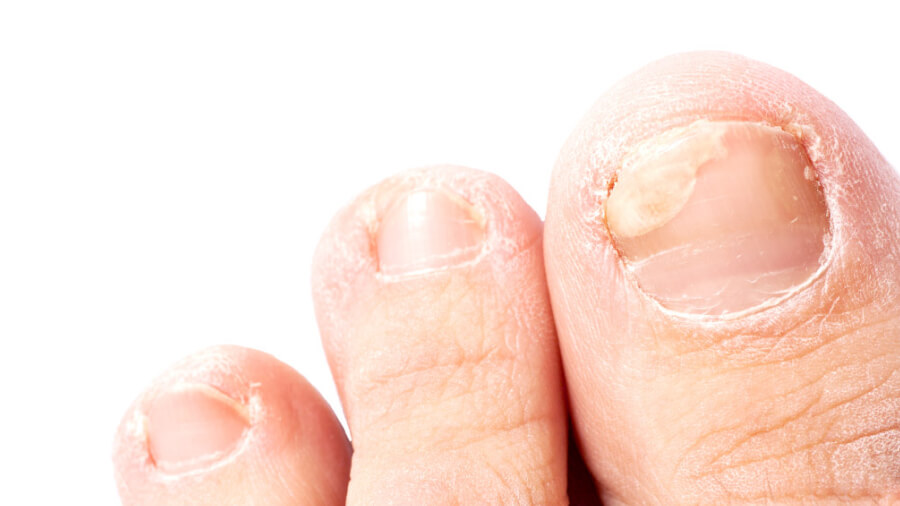
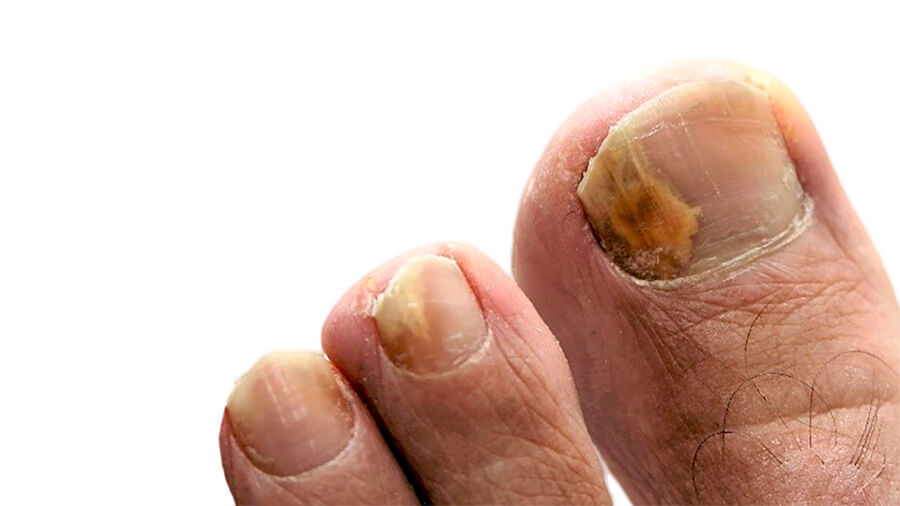
Bildquellen: Abb. 1 Monotherapie: © Nataliya Antonishchanka, stock.adobe.com; Abb. 2 Kombinationstherapie: Mit freundlicher Genehmigung Prof. Dr. Tietz, Institut für Pilzkrankheiten, Berlin